Healthcare AI Is Moving Into Live Hospital Environments: Why Continuous Monitoring Matters
More than 85% of patients who suffer an in-hospital cardiac arrest show abnormal vital signs six to 24 hours beforehand. Meanwhile, as many as 99% of hospital alarms are false, and only 16% of clinicians currently use AI for clinical decision-making. Here's what AI health monitoring actually changes about catching deterioration before it becomes a crisis, and where it still falls short.
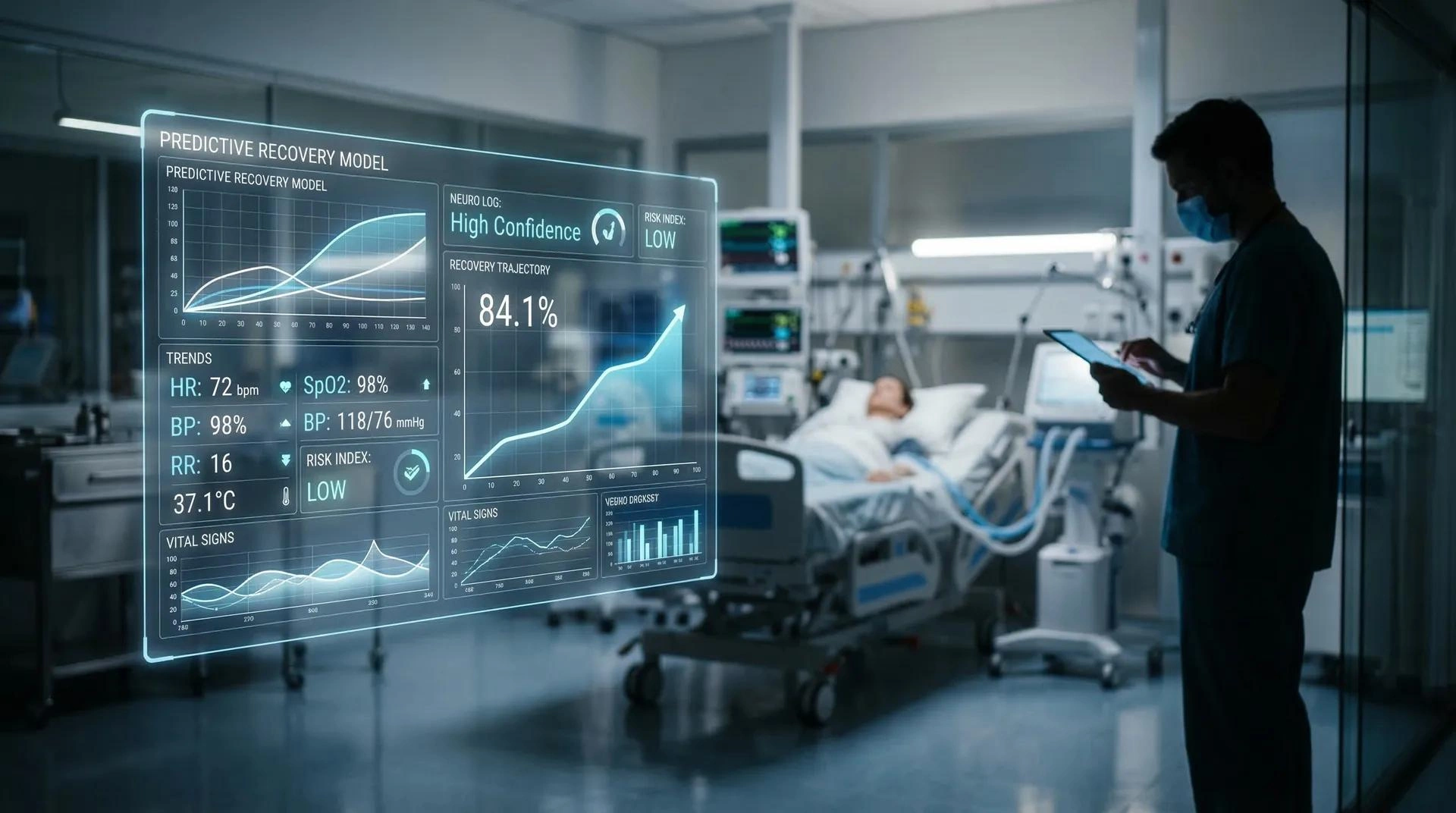
I've spent enough time in hospital IT and clinical engineering meetings to say this plainly: an alert is only as useful as the minute it reaches a clinician. AI health monitoring is no longer a research pilot tucked away in one ICU. It's live, it's bedside, and it's already changing outcomes. This piece breaks down how continuous AI health monitoring actually works inside a hospital, where it delivers the most value, and where hospitals are still getting it wrong.
AI Health Monitoring Enters the Live Hospital Environment
Walk any med-surg floor at 2 a.m. and you'll see the same routine you'd have seen a decade ago. A nurse checks vitals every four to six hours, then moves to the next room. Where does trouble hide? Right in that gap between checks.
A 2025 meta-analysis in BMC Medical Informatics and Decision Making found something worth sitting with: AI-based early warning models significantly reduced in-hospital and 30-day mortality rates when tested in prospective, real-world clinical settings, not just in the lab. That's AI health monitoring working on live patients, inside live hospitals, right now.
For years, "AI in healthcare" meant billing and scheduling. That's changing now. AI health monitoring has moved to the bedside. It watches vitals continuously, not in snapshots, and flags patients getting worse before anyone calls a code.
Why Real-Time Patient Monitoring Matters in Healthcare
Here's an uncomfortable fact most hospital leaders already sense: spot checks miss things. More than 85% of patients who experience an in-hospital cardiac arrest show abnormal vital signs six to 24 hours before the event. The data was there. Nobody was watching closely enough, because nobody could be, not every minute, on every patient.
AI health monitoring closes that gap. It doesn't replace nursing judgment. It extends it, catching the slow slide that spot checks were never built to see. AI patient monitoring makes that extension possible at scale, across a whole floor instead of one bed.
The skeptic's note: Vendors love a clean demo. A model that fires accurate alerts in a pilot and then floods a live unit with false positives hasn't solved alarm fatigue, it's rebranded it. Ask any AI monitoring vendor for their published false-positive rate before signing anything.
How Continuous AI Health Monitoring Works in Hospitals
At its core, AI health monitoring pulls data from bedside monitors, wearables, and the electronic health record. It runs that data through machine learning inference in real time. Instead of one blood pressure reading every few hours, continuous patient monitoring gives clinicians a live stream. Heart rate, oxygen levels, breathing rate, blood pressure, and lab trends all update around the clock.
These predictive clinical algorithms aren't simple alarms that beep when one number crosses a line. They're trained on thousands of past deterioration cases. The models learn what early decline looks like across several vital signs at once, not just one. When a pattern matches, the system fires an alert. Often that alert comes with AI clinical decision support attached, suggesting what to check next.
Real-time data streaming is what makes any of this useful. AI patient monitoring only helps if the analysis reaches a clinician while there's still time to act. Miss that window, and the smartest algorithm is just an interesting dataset.
AI Health Monitoring vs. Traditional Spot-Checking
| Parameter | Traditional Inpatient Vitals Spot-Checking | AI Health Monitoring Systems |
|---|---|---|
| Data Collection Frequency | Every 4–8 hours, recorded by hand | Continuous patient monitoring, updated second by second |
| Core Clinical Objective | Confirm stability at one point in time | Detect trends and flag deterioration before it becomes a crisis |
| Alert Management & False Positive Control | Fixed thresholds, no context between checks | Pattern-based alerts, filtered through AI clinical decision support to cut false positives |
| Integration with Clinical Workflows | Manual charting, delayed escalation | Built into the EHR and nurse call system, with real-time escalation |
AI Health Monitoring for Early Detection of Patient Deterioration
Sepsis is the clearest proof point we have. The FDA approved an AI-powered early warning system for sepsis in May 2026, built at Johns Hopkins. It had already cut sepsis deaths by nearly 20% across dozens of hospitals and detected cases two to 48 hours earlier than traditional methods. Every one of those hours counts, since sepsis mortality climbs the longer treatment gets delayed. It's a textbook case of AI clinical decision support changing an outcome, not just a dashboard.
This is what continuous patient monitoring is for. It's not about replacing a nurse's instincts. It's about giving those instincts a head start, measured in hours, sometimes days. AI health monitoring doesn't diagnose anything on its own. It narrows the list of patients who need a second look, before the monitor numbers turn into a rapid response call.
Pattern-based detection, e.g. Johns Hopkins TREWS
Reads vitals, labs, and EHR trends together to flag sepsis risk before a clinician would suspect it.
Waiting for visible signs
Relies on fever, confusion, or other symptoms that can just as easily point to something else entirely.
Where AI Health Monitoring Can Make the Biggest Impact
Not every unit needs the same flavor of AI patient monitoring. Assuming otherwise is a fast way to stall a rollout. Decisions about where to start AI continuous patient monitoring in hospitals should follow patient risk, not convenience.
In the ICU and step-down units
Continuous monitoring hardware already exists here. AI mostly adds prediction on top of data that's already flowing, through AI clinical decision support built right into the monitor.
On the general medical-surgical floor
This is the biggest opportunity, and arguably the most overlooked one. General wards still run on spot checks. That's exactly where AI health monitoring catches deterioration between rounds.
Beyond the hospital walls
AI patient monitoring doesn't stop at discharge. AI remote patient monitoring extends the same logic to patients just sent home, watching for early readmission signs before they happen. Hospitals running AI remote patient monitoring programs report fewer 30-day bounce-backs.
Real Deployments Already Running
This isn't theoretical. A handful of named systems are already live in hospitals, with published outcomes:
- TREWS (Johns Hopkins). FDA-approved in May 2026 for sepsis detection. Cut sepsis deaths by nearly 20% and flagged cases two to 48 hours earlier than symptom-based methods, across a study spanning more than 590,000 patients.
- CHARTWatch (Unity Health Toronto). An AI early warning system on a general internal medicine ward, built with real-time alerts to nursing and physician teams rather than a standalone dashboard, associated with fewer unexpected deaths.
- VitalCare (Presbyterian Medical Center, South Korea). A continuous patient monitoring system covering both the general ward and ICU, trained to recognize multiple deterioration patterns rather than a single clinical event.
Challenges of Implementing AI Health Monitoring in Hospitals
Why does any of this matter if clinicians don't trust it? A 2025 Elsevier survey of more than 2,200 clinicians across 109 countries found that only 16% currently use AI for clinical decision-making, even though nearly half want to. Just 32% felt their institution gave them adequate access to AI tools, and only 29% said their organization had adequate AI governance in place. That trust gap follows AI remote patient monitoring home with patients too, not just inside the building.
Alert volume is already a problem on its own. Hospitals have spent a decade fighting alarm fatigue, with research putting the share of non-actionable alarms as high as 72% to 99% on some units. Bolt a poorly tuned AI layer onto that noise, and you haven't helped anyone. You've just added more beeps for nurses to learn to ignore.
Rolling out AI continuous patient monitoring in hospitals fails for reasons that rarely involve model accuracy. Getting it right means training the AI clinical decision support layer to suppress noise, and treating clinicians as co-designers of AI patient monitoring, not end users.
Where Hospitals Actually Stand in 2025
| Metric | Figure | Source |
|---|---|---|
| Clinicians currently using AI for clinical decisions | 16% | Elsevier, 2025 |
| Clinicians who want to but haven't yet | ~48% | Elsevier, 2025 |
| Institutions with adequate AI access, per clinicians | 32% | Elsevier, 2025 |
| Institutions with adequate AI governance, per clinicians | 29% | Elsevier, 2025 |
| Hospital alarms that are non-actionable | 72–99% | Alarm fatigue research |
Key Benefits of AI Health Monitoring for Hospitals
Strip away the vendor language, and the case for AI health monitoring comes down to a short list:
- Earlier detection. Hours, sometimes days, of extra lead time on deterioration that spot checks are structurally built to miss.
- Fewer, better alerts. When properly tuned, AI clinical decision support cuts noise instead of adding to it.
- Extended nursing capacity. Continuous patient monitoring watches a whole floor, not one bed at a time.
- Fewer readmissions. AI remote patient monitoring catches decline after discharge, before it becomes a 30-day bounce-back.
- An auditable trail. Continuous data logging supports quality review and regulatory reporting in a way spot checks never could.
The Future of AI Health Monitoring: From Alerts to Predictive Healthcare
The next phase isn't more alerts. Expect three shifts over the next few years:
- Fewer, sharper alerts. Tied to an actual risk trajectory instead of one vital sign crossing a line, moving from "something just changed" to "here's what's likely to happen next, and what to do about it."
- Quieter AI clinical decision support. As models mature, expect less noise, not more, and tighter integration into existing workflows rather than a bolted-on dashboard.
- Predictive logic moving beyond the ward. The same approach behind AI remote patient monitoring today will likely run the general ward tomorrow.
That's a real shift in how hospitals operate, from reactive rescue toward predictive care. I don't think it replaces the rapid response team. I think it changes how often that team gets called too late to matter.
A Note on Sources
This piece draws on 2025–2026 peer-reviewed research and primary reporting rather than vendor marketing: a meta-analysis in BMC Medical Informatics and Decision Making, deterioration-timing data published via JMIR, the FDA's May 2026 approval of the Johns Hopkins TREWS sepsis tool, published outcomes on CHARTWatch at Unity Health Toronto, Elsevier's 2025 Clinician of the Future survey, and long-running clinical research on hospital alarm fatigue.
Where figures conflict across sources, as they sometimes do in a fast-moving field, we've favored the most recent, most directly attributed number and named the source in the text rather than presenting a single blended figure.
Frequently Asked Questions About AI Health Monitoring
1. Does AI health monitoring replace nurses at the bedside?
No. It's decision support, not a replacement. AI health monitoring flags risk. Clinicians still assess, decide, and act. Systems like CHARTWatch at Unity Health Toronto work because they engage nursing and physician teams directly, not because the algorithm runs alone.
2. How is this different from a regular bedside monitor alarm?
A standard monitor alarms when one vital sign crosses a fixed threshold. AI health monitoring looks at patterns across several vital signs and lab values together, using predictive clinical algorithms trained on real deterioration cases. That's why it can flag risk hours earlier.
3. Is AI remote patient monitoring only useful for chronic disease management?
No. It's well established there, but hospitals increasingly use AI remote patient monitoring for post-discharge surveillance too, watching for decline that could turn into a readmission.
4. What's the biggest barrier to AI continuous patient monitoring in hospitals?
Trust and integration, not the underlying technology. Clinicians need to see fewer, more accurate alerts before they'll rely on a system. That system needs AI clinical decision support built into existing EHR and nursing workflows, not bolted on beside them.