Google, Apple, Salesforce and OpenAI Are Betting on AI Agents: What Businesses Need to Change
Four of the largest companies in technology are building software that starts from an objective, figures out how to do it and just does it. Here's what that means for your business.
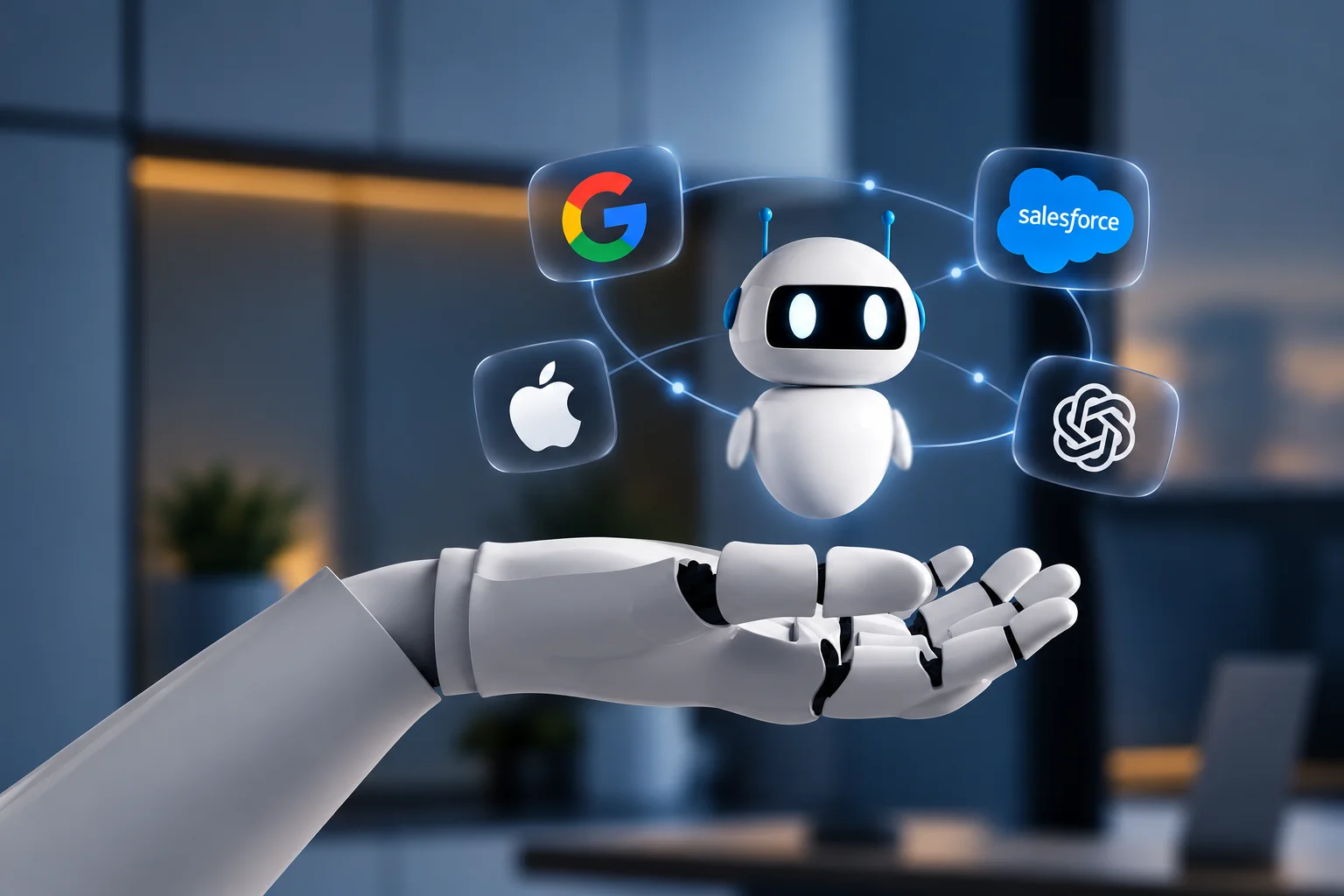
Business software has always been patient. It sits there until somebody clicks. It’s changing, and rapidly. In fact, four of the largest companies in technology are currently developing technologies that start from an objective, figure out how to do it and just do it. If you’re looking at whether to automate processes using AI this year, it will pay dividends to know what has changed, why it’s being done and what you need to do.
What Are AI Agents and Why Are They Becoming a Business Priority?
An AI agent is a computer program which operates towards achieving a certain objective without having to be guided through all the required actions. Instruct the software to address a billing issue, and it will choose what to investigate and what instruments to employ. A chatbot responds to your query and stops.
So why the sudden attention? Because most offices still run on human glue. Someone copies figures between systems. Someone else chases a sign off. Agentic AI solutions go after exactly this connective work, the dull kind nobody tracks. Better language models and safer ways of linking them to company data have also moved AI agent development from lab curiosity to budget line. Sound AI automation for business no longer stops at fixed rules.
Adoption still lags, though. When Google launched Gemini Enterprise, a Gartner analyst noted that most large companies were still testing agents instead of running them at scale. Firms that treat AI agents as a planned change to how work gets done, rather than a side experiment, will close that gap first.
How Google, Apple, Salesforce and OpenAI Are Shaping the Future of AI Agents
Each of the four starts from a different place.
Google: One Platform, Open Standards
Google has gathered its work under the Gemini Enterprise banner. Companies can build, deploy and manage agents there, with tools for auditing them. Its Agent2Agent protocol is an open standard that lets agents from different platforms pass work to each other. For anyone investing in AI agent development, that matters: it makes vendor lock-in less likely.
Apple: Agents Inside the Device
Apple is coming at this through the phone and the apps people already carry. Given that Siri has 27 apps to work on at WWDC 2026 with the help of App Intents framework, it can explore inside an app, perform tasks based on its findings and read everything from the screen. The message is clear for any company that owns a mobile app if the app does not speak about its capabilities, it cannot be used by any assistant.
Salesforce: Agents Built on Customer Data
Agent force runs on top of the customer data Salesforce owns and continually adds pre built agents for different verticals. When it comes to building an AI agent for sales and service use cases, this is what one can expect an agent that is aware of the account’s past, knows company policy and keeps the CRM updated automatically. Agentic AI solutions in finance and support follow much the same logic.
OpenAI: Agents as Coworkers
OpenAI introduced Frontier in February 2026 as a place to build and manage agents with shared context and clear permissions. In April it added workspace agents to ChatGPT. These run multi step workflows across tools such as Slack, and administrators can require human approval before an agent sends a message or edits a record. An updated Agents SDK adds sandboxing, so AI agent development can happen in a controlled space.
Four routes, one direction. Each company is treating AI agents as software that acts rather than waits.
AI Agents for Business: How They Are Changing Everyday Workflows
AI Agents for Marketing
AI agents for marketing can watch campaign results, notice that click through rates have slipped, draft a fresh ad and queue it for approval. A person used to spend Monday morning pulling those reports. Now the report is simply there. AI agents for marketing also help keep claims consistent, because every draft gets checked against the same brand rules.
AI Agents for Sales
AI agents for sales research a prospect before the call, log the notes afterwards and send a follow up that mentions what was said. The rep still owns the relationship. What disappears is the data entry that keeps people from selling.
Support and Operations
For that purpose, an agent can read a ticket, process the order and send a refund accordingly. In the financial context, it will match the invoice to the purchase order and detect any irregularities. This is how the implementation of artificial intelligence in real business goes.
Comparative Analysis: Traditional Automation vs. Autonomous AI Agents
| Parameter | Traditional Workflow Automation | Autonomous AI Agents |
|---|---|---|
| Core Operational Model | Follows fixed rules: if this happens, do that. | Works toward a goal and picks its own actions. |
| Execution & Decision Flexibility | Breaks or stalls when a case falls outside the rules. | Adapts to new situations and hands over to a person when unsure. |
| Handling Multi Step Tasks | Every step is mapped by hand, and each branch needs its own rule. | Plans the sequence, tracks progress and corrects its own mistakes. |
| System Integration Requirements | Needs a fixed connection built for each pair of systems. | Connects through APIs and shared protocols, and chooses the tool it needs. |
Neither wins outright. A payroll run that must follow identical rules should stay rule based. A messy request that crosses three departments is where an agent earns its keep. The best AI automation for business hands each job to the right tool.
From Automation to Autonomous Action: What Makes AI Agents Different?
Picture a refund request. A traditional workflow checks whether the amount sits under a set limit, then approves or rejects it. Anything odd lands in a queue.
The agent scans the customer's email, reviews the purchase order, reviews the company's return policy, and notes that the package was delivered late. Then, it processes the refund and identifies the problem with delivery. In case anything seems odd, it stops and asks.
It takes four abilities for an agent to do all of this: planning, tool usage, contextual knowledge and knowledge of when to stop. The latter ability is more important than the other three. An agent that recognizes its limits can be helpful, while an agent that does not know its limits is more harmful than helpful.
What Businesses Need to Change Before Implementing AI Agents
Buying the technology is the easy part. The harder work happens inside your company, and agentic AI solutions succeed or fail on it.
Clean Up Your Data
An agent is only as good as what it reads. Duplicate customer records, stale price lists and product names spelled three different ways lead to confident mistakes.
Write Down How Work Really Gets Done
Plenty of processes live in someone's head, and an agent can't follow what nobody has described. Map the steps and the exceptions.
Decide Where People Stay in Charge
Set limits before launch. What may an agent do alone, what needs approval and what is off limits? A small refund might be fine. Changing a contract is not.
Start with One Narrow Use Case
Select something repetitive, rules based and risk-free. Those who use AI agents to conduct marketing usually initiate themselves by reporting, while those who use them to do sales start by conducting research on leads. Regardless of where you deploy your AI agents, define what success is and measure it for a month. The person who commissions the building of an AI agent needs to ask the vendor one simple question, and that is: “What exactly will this agent be able to do?”
AI Agents and Enterprise Systems: Connecting CRM, ERP and Business Data
An agent that can't reach your systems can only talk. Useful AI automation for business begins when it can read from and write to your business records.
The CRM contains customer history, opportunities, and communications. The ERP contains orders, inventory, invoices, and information about suppliers. Now imagine a customer contacting you because of a delayed order a connected agent checks the shipment in the ERP, reviews the customer notes in the CRM and gives an answer within minutes.
Before, integration would imply custom coding lasting for months for each pair of systems. New shared standards are shifting the paradigm. Google Agent2Agent protocol, along with the Model Context Protocol that many big players have started to use, provides a standard way for agents to access other tools and connect with each other. As important are the permissions an agent must have access only to the resources the user has access to. Any good development of AI agents must account for it.
It concerns mostly sales and marketing departments. The sales related AI agents need fresh data on the pipeline, emails and pricing policies, while the marketing AI agents need to know the history of campaigns. Any agentic solution created based on outdated or fragmented data will let the customer down regardless of the model used.
The Benefits, Risks and Challenges of Adopting AI Agents
The Benefits
The first benefit of AI agents would be the saving of time. The follow up, reconciliation, and first drafts can take place anytime during the day. An organization using AI agents for sales or AI agents for marketing could complete tasks that required hiring of additional people.
The Risks and Challenges
Agents make mistakes, and they make them quickly. Security is another worry. Hidden instructions in an email or web page can steer an agent, a threat known as prompt injection. Costs can surprise you as well. AI agent development is only the first bill, since usage based pricing grows with activity.
The practical answer is oversight: logs someone reads, approval steps for sensitive actions and a named owner for every agent. Agentic AI solutions pay off when companies plan for those basics and set realistic goals for AI automation for business.
FAQs About AI Agents and Business Adoption
1. What is the difference between a chatbot and an AI agent?
A chatbot answers questions inside a conversation. An AI agent takes a goal, plans the steps, uses connected tools and finishes work across systems.
2. Are AI agents safe to use with customer data?
They can be, with the right controls. Limit each agent to the data it needs, require approval for sensitive actions and keep activity logs.
3. Do we need developers to get started?
No, not always. A lot of agentic AI solutions have no-code builders that would cope easily with simple processes. But custom implementation, such as integration with an ERP system, is usually a job for professional engineers.
4. Which teams benefit first?
Teams with repetitive work and rules achieve success the quickest. Marketing and sales teams are often chosen, as AI agents for marketing deal with reporting and drafts while AI agents for sales deal with research and updating CRM information.
5. Will agents replace employees?
It is more likely that AI agents will change the role of an employee than eliminate his/her role. Routine operations will be handled by AI agents while humans will handle judgment and exception handling tasks. Alert employees about which tasks are going to be automated using AI.